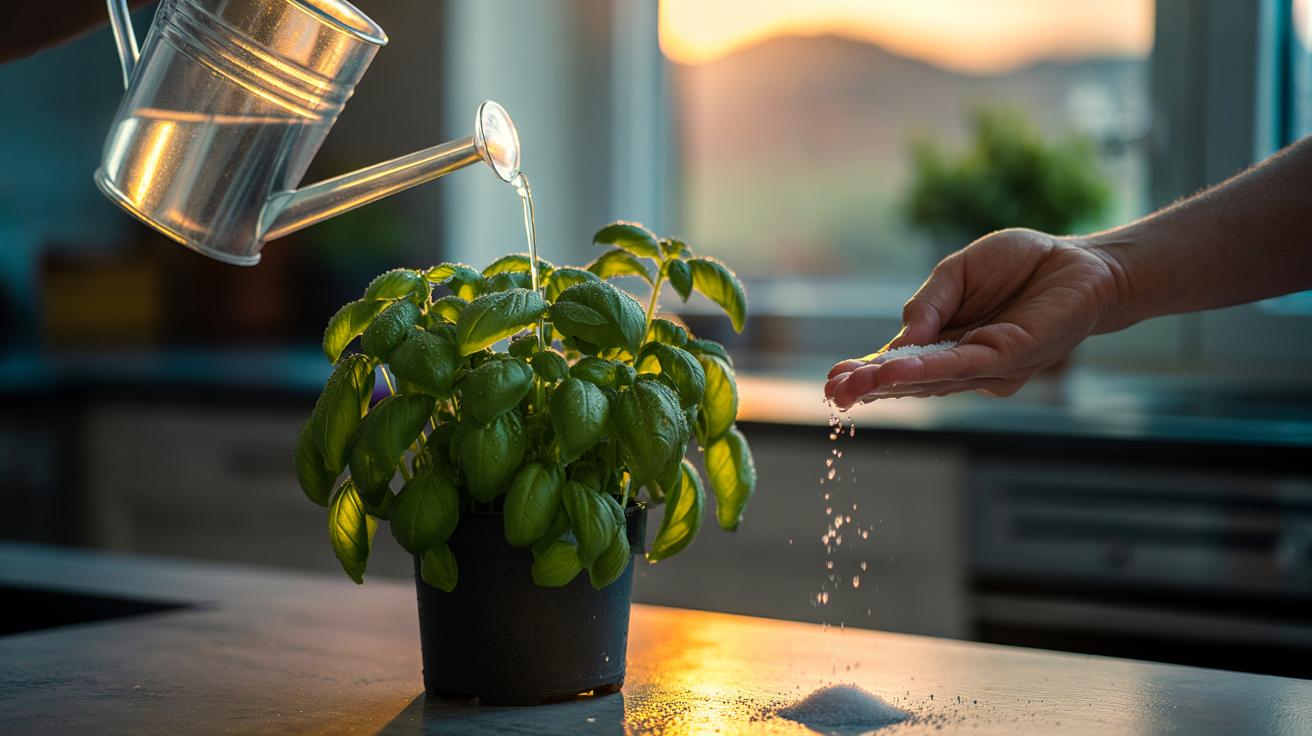
In a nutshell
- 🌿 A very dilute salt solution can trigger mild osmotic stress that boosts basil’s volatile oils and leaf firmness overnight—basil is a salt-sensitive glycophyte, so never use seawater.
- 🧪 How-to: dissolve 0.3–0.5 g/L (about 1/16 tsp per litre), target EC 0.5–0.8 dS/m, apply in the evening to well-watered plants, and use only once before harvest.
- ⚖️ Expect a boost in flavour, aroma, and texture—it’s about quality, not yield; results are clearest on vigorous plants with strong light and good pruning.
- 🚫 Risks and red flags: container salt build-up, leaf-edge burn, slowed growth—flush with fresh water after use and do not stack doses or use “grey” salty water.
- 💡 Alternatives and essentials: try kelp extract, light Ca–Mg, or gentle foliar feeds; keep soil airy and light bright, making the saline “pinch” an occasional seasoning, not a habit.
Headlines promise miracles. Gardeners know better. Yet a small, carefully measured dose of salt in water is making noise among herb lovers who swear their basil stands perkier and tastes punchier by morning. The science isn’t sorcery; it’s plant physiology. Mild salinity can nudge basil into protective mode, concentrating oils that deliver aroma and flavour. Done wrong, it’s ruinous. Done right, it’s subtle but noticeable. Never mistake this for a green light to pour seawater into your pots. The trick is not abundance but precision. Here’s how a pinch of science—and a literal pinch of salt—can help you harvest a seemingly richer basil bounty, fast.
What ‘Salt Water’ Really Means for Basil
First, definitions. Basil is a glycophyte, a salt-sensitive plant. Seawater and strong saline mixes scorch roots, collapse leaves, and stunt growth. Salt water, in this context, means a very dilute sodium chloride solution—so weak your tongue barely detects it. At low concentrations, salt imposes a light osmotic stress. That stress signals the plant to conserve water, slightly thicken leaves, and ramp up certain secondary metabolites tied to scent. Several horticultural trials have observed that while high salinity reduces yield, gentle salinity can sharpen flavour and affect leaf firmness for a brief window.
The sweet spot is small. Think 0.3–0.5 g of NaCl per litre of water, which corresponds to roughly 300–500 ppm of total dissolved solids, or about 0.5–0.8 dS/m electrical conductivity. Basil typically starts to struggle above 1.3–1.5 dS/m, and containers concentrate salts faster than open beds. Translation: the margin for error is narrow. It’s not a growth hack for lazy watering; it’s a controlled nudge that can make basil feel fuller and smell stronger overnight—mostly by changing physiology rather than magically creating biomass.
How to Mix and Apply a Dilute Saline Tonic
Use non-iodised sea salt or rock salt if you can; regular table salt is acceptable at tiny doses. For a 1 L spray bottle, dissolve 1/16 tsp (~0.3 g). For a 5 L watering can, use 1/4 tsp (~1.5 g). If you own an EC meter, aim for 0.5–0.8 dS/m after mixing. Apply in the evening to clean, well-watered plants—never to thirsty basil. Lightly drench the soil or mist leaves until just shy of runoff. Do this no more than once before a planned harvest window.
| Target | Amount/Range | Notes |
|---|---|---|
| Salt per litre | 0.3–0.5 g (1/16–1/10 tsp) | Stay low; pots concentrate salts. |
| EC (if measured) | 0.5–0.8 dS/m | Include your tap water baseline. |
| Frequency | Once before harvest | Avoid weekly use. |
| Timing | Evening | Reduces scorch, improves uptake. |
| Method | Light soil drench or fine foliar mist | Clean leaves beforehand. |
Expect a modest overnight shift—firmer leaves, a livelier nose, and, for some varieties, more persistent flavour after chopping. Rinse the pot thoroughly with fresh water one to two days later to prevent salt build-up. Never stack saline doses. That way lies leaf burn and slowed growth.
What You Can Expect Overnight
“Double your basil bounty” is a metaphor, not mass creation. Water in the evening, and leaves naturally rehydrate; add mild salinity, and the plant’s guard rises, which can intensify volatile oils by morning. Many growers report more upright stems and a fresher snap within 12–24 hours. In taste tests, that can read as richness—bigger, brighter basil with less bruising in the bowl. The immediate payoff is quality, not kilograms.
Don’t expect miracles on stressed plants. If your basil is rootbound, shade-starved, or chronically underwatered, salt won’t save it. This technique works best on vigorous plants already receiving six to eight hours of light, regular pruning above the leaf nodes, and consistent moisture. Try it the day before a pesto session or a Caprese feast. Take a small harvest from a treated plant and an untreated plant, sniff, then taste side by side. Some cultivars—Genovese, Napoletano—show clearer differences; others barely shift. You’re chasing nuance, not a yield lottery ticket.
Risks, Red Flags, and Safer Boosters
The danger isn’t the first pinch; it’s the build-up. Containers trap salts, saucers keep runoff in contact with roots, and warm weather amplifies evaporation, pushing salinity higher. Symptoms to watch: leaf-edge browning, dulling green, slowed new growth. If any appear, flush with plain water until it freely drains. Avoid saline tonics after a fertiliser application heavy in sodium or chlorides. And never use “grey” salty water from pasta pots or dishwashing—oils and surfactants damage leaves.
Prefer gentler boosts? Reach for kelp extract or seaweed tea (rich in potassium and trace hormones), a light calcium-magnesium supplement for sturdier cell walls, or a quick foliar urea at very low dose for greener leaves—each kinder to roots than sodium chloride. Improve structure with a peat-free, well-drained mix and add perlite for airflow. Prune regularly; it redirects energy into new, tender growth. Provide bright, unfiltered light or a full-spectrum LED at 250–400 µmol/m²/s. Get these basics right and the saline nudge becomes optional—an occasional seasoning, not a staple.
Used with precision, a tiny saline tonic can create the impression of a bigger, better basil pick overnight—crisper leaves, louder perfume, cleaner cuts. It’s a seasoning trick, not a substitute for light, water, and good soil. The rules are simple: go low, go slow, flush after. Keep notes. Compare results by smell, texture, and yield, and decide if the nuance is worth the ritual in your kitchen garden. When you next reach for pesto perfection, will you try the pinch—or stick with the classic, unsalted path?
Did you like it?4.4/5 (27)